Entries for the 'Uncategorized' Category
School Facilities Master Plan for Orleans Parish: Eastbank High Schools
February 26th, 2008
On Saturday, I attended the SFMPOP community meeting for the Eastbank High Schools. Since the meeting summaries posted on their website aren’t actually meeting summaries, but rather compilations of the same building summaries posted here, here are my slapdash notes from what I saw for anyone who might be trying to follow any of this from home:
I got to the meeting a little bit late, but apparently the meeting started late, so I hadn’t missed too much. A couple staff members filled me in - there were questionnaires on the school site proposals for everyone to fill out. There had been a brief presentation on what the scenarios meant (e.g., replace on new site, repurpose existing site, renovation, replace with new school on site, additions to meet standards, quick start). Tables were marked with sign for a specific school. Participants were asked to sit at the table for the school they were interested in - those who didn’t come with an interest in a particular school could join any table they want to. Several schools had no one at their table. (A participant I spoke to later said that at one of the elementary school district meetings she’d been to previously, the same sorts of scenarios were presented, but participants were not grouped by school-of-interest.)
After the groups were given time to discuss the scenarios at their tables, the staff conducted a school-by-school presentation. The data presented on each school was brief - address, date(s) of construction, site acreage - a little less information than what’s available on the building summaries. Participants were supposed to use this information, and whatever they discussed, to rate the desirability (high, moderate, low, no opinion) of the scenarios for each of the schools (most had only one scenario), not just the one they discussed at their tables. Participants were not asked to share with the whole group what they discussed concerning their particular school.
Following the school presentations, there was a general questions-and-answers period, which was the somewhat more informative part (at least to me). The school-by-school scenarios, and whatever notes I happened to get on them (in italics), are below the Q&A:
Q&A (end of meeting):
Q: Existing schools already have leadership teams (faculty, administration, students, parents, etc.) They should be part of this process.
A: “That’s a great idea.” Vallas announced a plan on Thursday to organize involvement of existing groups, and planning team will come to visit interested PTO’s, churches, and community groups.
Q: Have you looked at creating shared facilities at schools that are near each other?
A: We’re looking at aggregating resources.
Q: What’s the timeline for the PM/NOCHC school reopening?
A: End of summer, early fall.
Q: What’s the funding?
A: Initially, FEMA money. FEMA only pays for storm-related damage though, so that won’t address all the needs. Part of the planning process is asking, “how do we fund public school [buildings - expansion, renovation, etc.] in the future?” Traditionally new building/rebuilding has required referendums - that might not be enough. Looking at funding models from Ohio, North Carolina, and Arkansas. Ohio pledges state money from their tobacco settlement. Something like that could be put in bonds, to provide longer term funds-availability. There needs to be dedicated funds allocated to a School Building Authority.
Q: Have you taken student diversity (race, class) into account?
A: “Um, yeah, I think.” We’re obligated to provide the best facilities, to take care of devastated schools, and to see to the equitable distribution of funds. (Said nothing about demographic composition of districts)
Q: re Carver: are the plans for the school itself and for the site as a whole (recreation supersite) lumped together?
A: They intend to keep the school itself in the area, although there are flooding plans. The site is huge. and a Master Plan for that site will be required. Possibility of relocating Edwards Elementary.
Q: Shouldn’t schools currently using portable classrooms be the first priority for rebuilding?
A: The modular classrooms are approved for use for 3-5 years, ideally they’ll be done in 3. The transition may need to be done incrementally. (Said nothing about priority relative to other schools)
Q: In the past, students created “unique need” facilities - e.g., on site daycare (Early Childhood Development centers) and health care. How will these be reincorporated?
A: We’re actively working with the people who provide the health clinics. We’re designing capacity for health clinics. We only plan the facilities, not what goes on inside them - daycare is something that would have to be referred to the superintendents.
Q: Density of students in a given district is skewed right now. Areas still being rebuilt will have higher student populations in the future, and since many families are currently staying with friends or relatives in less-devastated areas, those student populations may go down. Is this being taken into account?
A: We’re looking at 10-year population projections, and considering short-, medium-, and long-term needs.
Q: For school sites being repurposed - are there plans for new charters at any of those sites?
A: That’s a question for Vallas et al. The Master Plan is only about the site and the facility.
SCHOOL-BY-SCHOOL SCENARIOS
Abramson
Scenario A: Replace on New Site/Repurpose Existing Site
* Over 50% damage (FEMA estimate). Might relocate somewhere between Read Blvd and Industrial Canal (no specific site yet). Immediate neighborhood has indicated that they DO NOT want a high school where Abramson was.
Franklin
Scenario A: Moderate Renovation
Kennedy
Scenario A: Repurpose Existing Site
* Option of moving former Kennedy students to the new Lake Area high school. The Kennedy site is very low, but not over 50% damaged according to FEMA - this raises “issues” over what can be done with the property. The Lake Area school can’t be located there.
Lake Area
Scenario A: Quick Start (New Construction Underway)
* “Quick Start” - goal to complete design stage by March, begin construction in April, and open for Fall 2009. Possibly to be located somewhere along Paris Ave.
Reed
Scenario A: Moderate Renovation
Carver
Scenario A: Replace with New School on Site
* Very large site (65.23 acres) - proposed “supersite” for recreation, with baseball diamonds, Olympic-size swimming pools, etc.
Clark
Scenario A: Moderate Renovation & Additions to Meet Standards
* Needs additional space for parking, open recreational space. Does not necessarily need to be located right next to the school, could be found elsewhere in the neighborhood
Douglass
Scenario A: Major Renovation & Site Expansion
Scenario B: Replacement on New Site and Repurpose Existing Site
* Two scenarios! Very narrow site. Sounds (to me) like repurposing is what SFMPOP is pushing for, but that’s just my impression.
Lawless
Scenario A: Repurpose Existing Site
* Site to be repurposed; new school may be opened in Jackson Barracks area or Lower 9th Ward. May partner with military for school for neighborhood and National Guard families.
McDonogh 35
Scenario A: Replace with New School on New Site/Repurpose Existing Site
Scenario B: Major Renovation & Site Expansion
* Needs more space
New Orleans Center for Education of Adults
Scenario A: Repurpose Existing Site
* No plan to rebuild elsewhere
Cohen
Scenario A: Moderate Renovation & Site Expansion
* Has had renovation work done fairly recently, more to come. Needs more space: neighborhood properties might be available through Road Home Program properties.
* audience question: When will renovation start, and what will happen to the students while it takes place?
* answer: the Master Plan will have the timeline (which hasn’t been settled yet), and they’re working on establishing “swingspaces” - temporary school sites for students whose schools are being repaired/rebuilt (no set location yet)
Lusher
Scenario A: Major Renovation & Additions to Meet Standards
McMain
Scenario A: Replace with New School on New Site/Repurpose Existing Site
Scenario B: Major Renovation & Additions to Meet Standards
Priestly Junior High
Scenario A: Major Renovation & Additions to Meet Standards
Scenario B: Replace with New School on Existing Site
Rabouin
Scenario A: Major Renovation & Addition to Meet Standards & Site Expansion
* Needs a gym - originally an all-girls’ school (no gym provided). A property nearby has been identified (did not say which property)
Derham
Scenario A: Repurpose Existing Site
* Has not been used as a school for quite some time
Easton
Scenario A: Major Renovation & Site Expansion
* Presently using a field 6 blocks away for football practice. Needs closer space, looking at properties in neighborhood
John McDonogh Senior High
Scenario A: Major Renovation & Addition to Meet Standards & Site Expansion
* Proposal floated by staff presenter to demolish current gym and rebuild a gym and band facility (band currently practices in main building, disrupts classes)
New Orleans Center for Health Careers
Scenario A: General Maintenance & Additions to Meet Standards
* Currently being renovated - I got the impression that the site is used mainly for the Orleans Parish PM school now
N.O. Science & Math
Scenario A: New Site
* Must find new site - former site was leased from Delgado, and is no longer available.
Washington
Scenario A: Major Renovation & Additions to Meet Standards & Site Expansion
* Some renovation over the last couple years. Looking at nearby properties to expand.
POSSIBLE NEW SCHOOLS
There was no specific presentation of these schools - only what was already mentioned relating to other schools that might be disbanded, with students to be relocated at these (e.g. Lawless):
Abramson
Scenario A: New School on New Site
Jackson Barracks
Scenario A: New School on Existing Available Site
Lower 9th Ward
Scenario A: New School on New Site
Dark Ages
December 20th, 2007
Well, the forces that maintain that HANO’s and HUD’s (and New Orleans’ and America’s) chief fault is bad feng shui seem to have won. I guess it was foolish to have ever thought it would be otherwise - sorcery really is pretty powerful, in City Hall anyway.
Truest Words Ever Written
September 14th, 2007
On New Orleans climate:
“For summer there, bear in mind, is a loitering gossip, that only begins to talk of leaving when September rises to go.”
RIP Bruce Cat: ca. 1991 - 8/3/2007
August 5th, 2007
Bruce in 2007 - one eye shy, but as helpful as ever with crossword puzzles.
Many, many thanks to Crescent City Veterinary Hospital for all their superlative care, in life and death.
Robbing Peter to Pay Allstate
June 28th, 2007

Who really holds the keys?
I had to wonder whether it was with deliberate irony that yesterday’s Times Picayune placed the article N.O.’s plan for rebuilding passes Muster with LRA immediately beneath LRA feeds Road Home kitty, with it’s handy inset showing of the approximately $1 billion the state is adding to the Road Home program, $577.5 million is coming from CDBG funds previously slated for infrastructure repairs, and another $50 million was “carved out of other recovery spending areas” by the LRA. (The amount to be doled out for New Orleans rebuilding is $117 million - of the $1.1 billion that “officials” (whoever they are these days) say we need.) Oh, and that doesn’t count the $513 million the LRA now has access to since the 10% match of federal funds requirement was waived - $513 million the LRA had earmarked for parish recovery projects, of which New Orleans was to receive $324 million - so they can sit on it in case the state needs to ante up even more cash to help close the Road Home gap.
Today’s TP editorial, A good faith effort, claims that “repairs to storm-damaged state buildings and construction of a replacement for Charity Hospital in New Orleans,” which were to be paid out of the $577.5 million would be paid out of the state’s budget, but forgive me if I’m skeptical.
What really infuriates me is the nearly blind eye being turned to the source of a sizable chunk of the Road Home gap: insurance underpayment, to the estimate tune of $2.7 billion. To be fair, in May Blanco and Walter Leger recommended that the state pursue claims on the behalf of cheated policyholders - after all, what hope can individuals have suing the colossi piecemeal (the insurance industry is the only other field besides Major League Baseball exempt from antitrust regulation, making the combined insurers a pretty daunting monolith). But it looks like, yet again, insurers have passed the buck to taxpayers, and worse, the state and federal governments have chosen to bleed the programs that are underfunded already. Big surprise.
This is yet another instance of why the entire state and nation should be taking heed of Louisiana’s and Mississippi’s situation. Insurers - property, health, auto, etc. - are as consequence free everywhere as they are here. The number of ways in which the system is scandalously broken is too great for me to digest, but PLEASE check out the Insurance Transparency Project for much more - inspired by, but not exclusive to, Katrina’s insurance aftermath.
Family Wildlife
June 14th, 2007

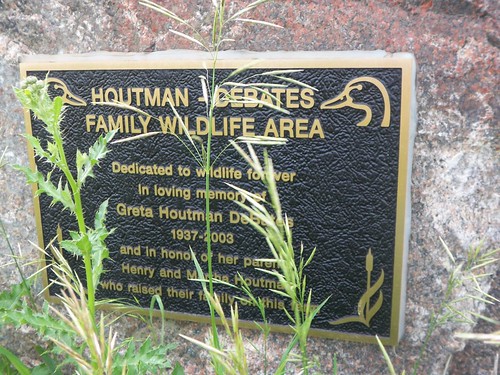
Greetings from Volga, South Dakota (The Town with a Future!), where I’m hard at work pissing off the local wildlife, along with my dad and my brother (they haven’t really been pissing off the wildlife - just me and my camera). This guy gave me an earful for intruding on his territory (he’s the one that sounds like “the grating of a rusty hinge,” not the nice twittering by his friends in the background (not pictured)). He ought to have conceded me at least a little courtesy though, because he’s living on the Houtman-DeBates Family Wildlife Area, thanks to my Aunt Greta and her husband Larry “Uncle Bates” DeBates, who bought my grandparents’ farm when they retired and eventually arranged a perpetual conservation easement for the property to revert to natural prairie and marsh.
I don’t know as much about conservation easements as I feel I should, and I think they vary somewhat from state to state, but it’s an interesting strategy to restore and preserve natural habitats. Owners who opt for an easement get tax incentives and retain title, control of access, and “compatible use” rights - hunting, fishing, trapping, etc. I have another uncle on my mother’s side who has a similar arrangement in Wisconsin, where he keeps bees and taps maple sap, among other things. They also get assistance restoring the property back to its natural state - burning off weeds, reintroducing native flora (hopefully fauna, like my angry friend above, follow too), restoring water exchange, or whatever else might be called for. And any new development or “non-compatible” use is prohibited for the life of the easement even if the title changes hands.
Louisiana’s DNR has a conservation easement program: the Louisiana Coastal Wetland Reserve Program. It’s a drop in the bucket of all the restoration Louisiana needs, I suppose, but every drop counts.
Now, off with the family to check out the Brookings, SD nightlife, which I suspect is not very wild…
Fare thee well my OS Linux, And farewell for a while
May 12th, 2007
That was more or less what my screen looked like the other day when I attempted to boot up. The 99’s ran to almost half the screen, taunting me without so much as an obscure command prompt or any sort of option whatsoever. I did what any sensible person would do - flew into a blind panic. What was this? Some hideous new White Album virus? Was the Number 9 all I’d ever see again on this machine (well, an L too, but that wasn’t very reassuring)? Turn me on dead man, indeed.
I couldn’t. Thankfully, after laboriously accessing google through on my teeny-weeny cell phone screen, I found (and was actually able to read, after a fashion) this post, which reassured me that this was not a virus or any such thing - just a hexadecimal error message. Thanks a million, Josh Highlands Blog - or rather, thanks 99 99 99. I had uninstalled Linux some weeks earlier, and long story really short, my Master Boot Record was exposed somehow to overwriting or something like that. Unfortunately, IBM Thinkpads don’t come with a Windows CD - in their infinite wisdom, they put the rescue and recovery business on the hard drive, in a special hidden “pre-desktop” area for those idiots who misplace their Windows disks. Well, the pre-desktop area was exactly what I couldn’t access, and although once upon a time I’d made my own set of recovery disks, I’m that idiot who misplaced them (I’m not even sure that they would have done the trick). Booting from an installation disk and running FIXMBR was not going to be quite so easy.
I called around to see if anyone else I knew with Windows XP still had their installation disks, but wasn’t having any luck, and I kept scouring the web for any alternative solutions. Fortunately, after I got crabbier and crabbier, Alan found a solution while I was at the grocery store, muttering Luddite curses under my breath, and I’m back in action again.
Of course, this L 99 99 99 business isn’t really the fault of Linux. After all, it came after the uninstall - well after. I’ve dabbled with Linux for several years, and for relatively long stretches of time I’ve used it as my primary OS. I’ve sung the praises of Open Source (and still do), and I’ve even enjoyed the many challenges of finding and installing the appropriate drivers to make fiddly hardware work. I found I wasn’t one to relaxen und watchen das blinkenlights, and gefingerpoken und mittengrabben have brought me close to schnappen der springenwerk, blowenfusen und poppencorken mit spitzensparken more than once. Ironically, my first installation was by far the easiest, and they’ve gotten more difficult with each subsequent PC. Then again, the next attempts were on laptops, which are notoriously trickier. But I soldiered on, skirting disaster with partitioning tools and bootloaders and reams of competing advice, and generally came out OK. I always kept a Windows partition as well, for the occasional bit of software that had no Open Source alternative, but rarely needed it. Until I went wireless.
I combed all the Linux for Laptop advice I could find, scoured everyone’s accounts of their installs on IBM T-series ThinkPads, and tried every avenue I could find. I’d battled with the “winmodem” issue in my first Linux install, which I ended up “solving” by buying a new modem (at 28.8, it was badly needing an upgrade by then anyway). It just wouldn’t work. Plugging in to DSL worked just fine, but I don’t have a laptop to just leave it tethered in one place, so I used the dearly-bought Linux partition less and less. I suppose by now there might be a solution, but I was just worn out with the constant searching required to catch my hardware up every time I upgraded. The Linux world is friendly enough not to throw around RTFM too often, but I’ve often wished there actually was an F-ing Manual somewhere. But Moses hasn’t come down from the mountain with that quite yet. Between the myriad flavors of GNU/Linux and the myriad flavors of hardware that vary even within the same make and model of PC, even the most patient, detailed, step-by-step accounts weren’t always enough for someone like me.
I like to think I’m a relatively savvy user, but I’m no system administrator, and I’ve spun my wheels in perpetual “newbie” status. In fact, I think I’ve aged out of newbie, and I’m reduced to Linux Dilettante (Linuttante?). Not that I haven’t learned quite a bit about the Man Behind the Curtain by having to solve Linux installation problems, but I just don’t have the time and attention to spare any longer. I’ve had to admit defeat. Temporary, I hope. I’m back to cursing and fuming at XP, but at least I’m online cursing and fuming.
It’s probably not a permanent abandonment - I keep hearing that the Linux desktop market is growing, which would seem to mean that the hardware and software conflicts that frustrate more “casual” users are getting sorted out faster and better, but then again, the immanent Linux desktop explosion has been “just around the corner” for years.
So, Fare thee well my OS Linux, / And farewell for a while.
A Satyr on Czar Blakely
April 11th, 2007
Apologies to the Earl of Rochester…
Poor Czar! thy prick, like thy buffoons at Court,
Will govern thee because it makes thee sport.
‘Tis sure the sauciest prick that e’er did swive,
The proudest, peremptoriest prick alive.
“I’ll finish when all of you think I’m finished.”
Agreed. Don’t let the door hit you on the arse on your way out, Ed.
HUD Mud
March 21st, 2007
I missed this last year, but surprise, surprise, Bush appointed HUD Secretary Alphonso Jackson was found to have “urged staff members to favor friends of President Bush when awarding Department of Housing and Urban Development contracts,” (Washington Post, 8/22/06). This after an anecdote he told at a Real Estate Executive Council forum in Dallas last April, about revoking a contract awarded for “a heck of a proposal” (is “heck of a” a required phrase in Bush Administration circles?) after the chief of the firm said he didn’t like the president (Dallas Business Journal, 5/5/2006).
Alphonso Jackson, Alberto Gonzoles, Michael Brown…
I have to doubt that HUD’s intervention in the Road Home Program at such a late stage was entirely on behalf of the beleaguered citizens of Louisiana.
I wonder whether self-lamed duck Blanco will find a stronger voice regarding “her” Road Home Program (with ICF, HUD, or anyone else) now that the re-election pressure is off, or whether she’ll wilt. Waterfowl can get pretty aggressive when they want to. (Seriously. There was this goose once, on my uncle’s farm…)

-
Road Home: Rebuilding vs Compensation »
I’m guest-blogging today at Think New Orleans on the flap between HUD and the State of Louisiana on whether Road Home is a rebuilding or a compensation program.
Comments (0)
Herring in Delft
January 26th, 2007

Okay, it’s raw, not pickled (sorry, Adrastos), but I did my tourist’s duty, and it wasn’t half bad. Still, I have to say I prefered pannekoeken and rijsttaffel as far as Dutch cuisine goes.
Grimm Decisions
January 6th, 2007
The eldest went first into the room where the slipper was, and wanted to try it on, and the mother stood by. But her great toe could not go into it, and the shoe was altogether much too small for her. Then the mother gave her a knife, and said, ‘Never mind, cut it off; when you are queen you will not care about toes; you will not want to walk.’ So the silly girl cut off her great toe, and thus squeezed on the shoe, and went to the king’s son. - Ashputtel (Cinderella), Grimm’s Fairy Tales
The F-word is in the air again. Or rather, it’s conspicuously not in the air, since the BNOB taught everyone what a dirty word footprint could be. Now, the buzz is about unrestrained rebuilding in “risky” areas, thanks in particular to the Washington Post’s New Orleans Repeats Mistakes as it Rebuilds article yesterday. The blogosphere is once again awash in “why are we letting those idiots spend our to rebuild below sea level?” rants (note, though, mominem’s lonely voice of dissent ranked on the first page of Google’s blogsearch). Oddly enough, the Post’s previous day’s story on Sacramento’s potentially catastrophic flood risk, observing that (surprise) it’s levees are substandard, didn’t warrant much blogland comment that I’ve been able to find.
I wouldn’t give the footprint topic the time of day if it were confined to knee-jerk New Orleans haters who think that our massive losses are costing them somehow, as if some enormous Save New Orleans tax were being levied on them personally. But I’ve heard the variations on the “you have to shrink the footprint” line from too many friends and relatives out of town - people who sincerely love New Orleans, visit here, visit more than just the French Quarter and Jazz Fest Fairgrounds, and want the city to survive almost as desperately as we residents do - to brush it off.
After all, it does seem eminently logical both to consolidate the population for the sake of providing services, and to run like hell from the worst-flooded areas. It’s true that we can’t expect to come back to pre-Katrina population density any time soon, if ever (and no one here wants their neighborhood to suffer the jack-o-lantern fate, or be surrounded by blight and vacant lots), and it’s completely fair to ask why one should rebuild in the deepest flood-risk zones. The trouble is, I’ve never seen the inevitable, costly consequences of a smaller footprint adequately addressed, even if race and class inequities could be somehow swept aside. And it does cost. It’s not an abstracted matter of so many puzzle pieces to be shuffled around, or cars in a valet parking lot. It’s a question of where real people can live, and how we can afford to make decent housing available in a timely manner.
Even the UNOP’s Community Congress II acknowledged that one of the “cons” of the scenario of requiring people to resettle in ill-defined “clusters” was the greater cost than letting people rebuild where they lived before. If you think the Road Home program is falling short now, just imagine when homeowners are forced to take the buyout offer rather than renovate/rebuild, and the real costs of relocation come to the fore. I’m a little surprised that the Uniform Relocation Assistance and Real Property Acquisition Policies Act hasn’t been invoked yet, given that it’s a federal project that deprived the majority of New Orleans of their homes, but you can be sure that if or when people are denied the option to rebuild, the meaning and value of “comparable replacement dwelling” in the post-Katrina real estate market will be a magma-hot flashpoint.
Plenty of pundits (including Recovery Chief Ed Blakely, cited in the Post article) have proposed some vague sort of “lot swap” between badly flooded homeowners who want to return and scarcely flooded homeowners who have left, but would someone please show me these high-ground lots ready and waiting to be swapped? I know there are lots of people with high-ground properties who have relocated to other cities due to work or disgust, but which are the ones who aren’t seeking their newly boosted market value? What do we honestly have to offer people who are willing to sacrifice their immediate sense of home: their house or apartment, for their general sense of home: New Orleans? (Incidentally, the Post article notes that “Officials in St. Bernard Parish … rejected closing off a particularly hard-hit 36-block section of Chalmette because they could not afford to buy out property owners.” That doesn’t influence their conclusion that we’re Repeating Mistakes as We Rebuild, though.)
Another glaring omission from the footprint argument is the acknowledgement that ours was an unnatural disaster, and that that fact figures significantly into both what risk property owners and dwellers thought they were assuming before Katrina, and what risk we’re facing after. The Post does acknowledges that “the levees … proved catastrophically fallible,” but doesn’t factor in what every local now knows - that our degree of risk has far less to do with elevation than with the x-factor of where the next breaches might occur. Given that so far, the levees have been repaired mainly where they breached, and that miles of levees are still as substandard as before, everywhere but the repaired breaches will be under the same strain as before should a Katrina-like event happen again, with no telling which spots might give way first. And heaven forbid that the next threat should come via the river rather than canals to the lake, because then the highest, “safest” ground will be obliterated. We just can’t evaluate true flood risk while it’s more contingent on man-made negligence than natural vulnerability.
And encompassing both the population-consolidation issue and the flood-risk issue is the self-fulfilling prophecy dilemma. Repopulation is a matter of both just compensation to those who lost their homes and everything in them, and prevention of becoming a theme-park rather than a city. People weren’t stupid or foolhardy to choose to live and work in New Orleans, any more than people are stupid or foolhardy to live in Sacramento, San Francisco, or any coast, riverside, lakeside, barrier island, earthquake zone, tornado-swept prairie, blizzard, or avalanche territory. Offering and encouraging the option of return to the people who were flooded out is a moral imperative as well as an imperative to preserve the viability - not just of neighborhoods - but of the city. We need our population to back our deserved political clout at the state and federal level, and to remain a diverse city - racially, industrially, and economically. To retreat to the Sliver by the River is to cement our past history of inequality into an even more go-nowhere status as a low-wage, low-opportunity tourism town; a barely-get-by-ism that we will deserve to lose to another hurricane if we’re the ones who let it happen.
There’s no Fairy Godmother to tell us how to deal with flood risk and population shrinkage, but more importantly, there’s no Prince Charming who will take care of everything if we only make ourselves fit someone’s idea of what size slipper we should wear. We have excruciating decisions to make, but no one is in a position to tell us which toes can do without, any more than the knee-jerk New Orleans haters can say that the nation can do without us - our neighborhoods are no more socio-economic islands than we are as a city or a region. Nor can anyone tell us that sacrificing the 9th Ward, Lakeview, Hollygrove, Gert Town, or any of the flooded neighborhoods will make us a Queen who won’t need or want to walk. We’ll be crying “let them eat bread pudding” all the way to the guillotine if it ever comes to that.
Unsympathetic
October 20th, 2006
I first read the BGR’s report on Road Home’s rental housing a couple weeks ago, and it really got under my skin. And now it’s been cited in yesterday’s Times-Picayune front page article on the fate of public housing and the directions being taken toward affordable housing in New Orleans, it’s crawling out from where it’s been festering.
“Although ostensibly a recovery program, the Road Home rental program is at heart an affordable housing program.”
The Road Home Rental Housing Program: Consequences for New Orleans
Bureau of Governmental Research
First of all, it’s been my understanding that HUD’s Community Development Block Grant program is intended, in their own words “principally for low- and moderate-income persons,” so the LRA couldn’t not focus primarily on affordable housing even if it wanted to. Unaffordable housing ought to be able to take care of itself, as the BGR itself aptly pointed out back on August 24, 2005, in that other lifetime when Katrina was just a newly named tropical storm preparing to swat Florida.
Second, the spirit of alarm (gasp! an it’s an affordable housing program? in the Orange County I mean, Orleans Parish, recovery effort?) is telling. The BGR recognizes that the many legacies of poverty have hurt our city and citizens, but their high-minded, “objective,” “pure facts,” “no spin” (is there ever a clearer warning to keep your seatbelt fastened and your arms inside the ride until the Tilt-A-Whirl comes to a complete stop?) conclusion is that the remedy is to remove the poor, or a sizable number of them anyway. And being the ever-thorough BGR, they detail at great length their endorsement of the best means to accomplish this feat - move over Voodoo, there’s a new sympathetic magic in town: Feng Shui.
The BGR is probably too “advanced” to believe in elemental natures like Air, Fire, and Water, but that doesn’t mean they’re above the Move Your Poor, Change Your Life strategy of urban self-improvement which is so popular these days (they have plenty of company in HUD, and even the LRA to some extent, however harshly the BGR takes them to task).
It begins with skimming the excess: Poverty doesn’t have to go away entirely - you still have to take the yin with the yang, the dishwashers with the doyennes - but
“The geographic allocation formula [ i.e. - dispensing funds based on the percentage of damage] would continue to concentrate the region’s low income subsidized housing in New Orleans.”
That’s right, the BGR is so confident that the New Feng Shui will have us manifesting effortlessly that they’d rather New Orleans get less funding. Granted, they’re not without paternalistic concern for the less well-off: “So much of the money and jobs have gone to suburbs,” BGR President Janet Howard told the Times-Pic. We should “help lower-income people relocate closer to jobs that would help them climb the economic ladder.” Go off to a better life in other parishes (of course, not St. Bernard - you’re not welcome there unless you’re a blood relative). Don’t worry about us market-raters - we’ll soldier on alone, here in this economically stagnant, jobless hell hole.
After skimming the excess comes deconcentration. Too much of the Element in one place is just no good, however benign it may be in small amounts. Sure, there’s research on correllations between high concentrations of poverty and problems like crime and teenage pregnacy (although the correllations vary more from place to place than you might guess from casual mentions), but causation is far from proven, and doesn’t appear to be getting any closer. Nevertheless, Mixed-Income is a rallying cry far and wide, despite results that at their rosy-lensed, optimistic best have been, well, mixed (and whose relative successes aren’t necessarily measured by the lives of the “deconcentrated,” but by the real estate).
The mixed income strategy (or strategies, since the implementations have been all over the map regarding what sort of mixes, what income levels, ratios, building styles, etc., which makes the BGR report’s repeated conjuring of a “classic mixed income development” especially baffling) is least effective where it’s most predicated on trickle-down socialization. Did I say move over Voodoo? Maybe I spoke too soon - the one thing that can be said for supply-side economics is that we can all agree what side the supply is on. The notion that the above-AMI crowd is in exclusive possession of morals, work ethic, and all around upright behavior is rather less certain. If only being evil really did make you poor… Curiously, one of the BGR report’s harshest criticisms of the LRA and LHFA is that it has “attempted to achieve predetermined social outcomes” with this program by backing off somewhat from their original plan to engineer mixed income developments with high market-rate to low-income ratios.
What’s especially disturbing about this report is that the BGR doesn’t even believe it’s own rhetoric. Would any “research” organization worth its salt concede this: “Limited evidence exists to support the theoretical benefits of mixed income developments,” and still proceed? Would the weasel-worded “Many policy makers and scholars have expressed their preference” pass professional muster anywhere else? (The answer is sadly, yes, all too often, but it shouldn’t anyway.) No matter - the point isn’t to lift individuals out of poverty, it’s to reduce the Element. Why? Lest we “Impede the Growth of the Tax Base.”
The BGR is hardly without company in the stance that cities are made of tax bases first and citizens second - perhaps one among the “many policy makers and scholars” consulted was New Urbanist Andres Duany (speaking of Feng Shui spatial fixes), who’s said in the past that “affordable housing is not what cities need. Because they don’t pay taxes. They bankrupt cities.” (In another discussion with New Urbanism critic Alex Marshall, Mr. Duany gives us the delicious phrase: “to decant the monocultures of poverty.” ?!? Add alchemy to the growing list of mojos in play.) Does New Orleans need a stronger tax base? Of course. Should we watch what public subsidies are doled out for development projects and how? Like hawks. But are there really legions of well-heeled taxpayers lined up out there to fill the market-rate portions of these projects and solve all our economic problems if only we filter out the Element adequately? (Need a quick financial fix? try green candles Green Condos in your Wealth Corner.) A moment ago, New Orleans was such a wasteland that low-income workers were counseled to settle in other parishes post-haste - there’s no “economic ladder” to climb here, we kicked it away.
Poverty won’t be solved by any one magic bullet, spell, charm, or fetish, and if pretending we’ve neutralized it draws attention away from the needs of actual people in actual neighborhoods, we could leave city and citizens alike just as bad off as before (I’m really tired of the rationale that whatever we do couldn’t be worse than before just as long as we do it differently). Not to mention, lingering any longer on trying to attract developers and these mysterious market-rate renters to fill out the 60-80% units it’ll take to justify the 20-40% affordable units just limits repopulation (the tax base, the tax base!). The Rental Road Home plan may not be an absolute gem, but it’s time now to start getting people into homes again, not play mad social scientist. What color candle do we have to light to do that?
More Anniversaries
October 3rd, 2006
The anniversary of Rita’s landfall passed back on September 24, not completely without fanfare, but with rather less than Katrina’s. The fourth-most intense Atlantic hurricane ever recorded, and still no respect.
That means that it must have been just about a year ago today that I was heading back to Houston from Austin, leaving a day later than I’d planned while I waited for my cat to come out of the hole in the wall he found in my brother’s closet. Some friends and I had just made plans to head back into New Orleans for the first time, just to see how things stood with our apartments - I thought at that time that it would be a quick trip and that I’d still need to stay in Houston for some time to come. So I left the recalcitrant cats with my aunt and uncle, and a couple days later (I can’t remember quite how long), I was back on I-10 eastbound, wondering belatedly how far it would be before I reached a parish with an open gas station, and eyeing roadside shrubbery in case nature called before I found a town that wasn’t still wiped out.
It feels like almost the anniversary that August 29 was.
Pompeii
September 24th, 2006
I’m sort of touchy when it comes to “fine art” photography. Every medium has its own special challenges, but besides having its own set of technical requirements, photography seems to have an inherent journalistic plateau: after achieving a certain level of mastery of subject selection and composition, it’s pretty hard to differentiate oneself artistically from untold numbers of other talented photographers and what they’d capture given similar circumstances. No matter what really goes into taking a photograph, it almost always comes off to a viewer as just that - taking it, being there to chronicle it; a photographer rarely comes off as quite the creator of an image as say, a painter, a sculptor, or even a sketch artist.
Which isn’t to knock photojournalism, of course. There’s absolutely great talent and artistry there, and I wouldn’t even go so far as to say that “capturing” reality is less difficult or less lofty than “creating” art. But it’s a different claim than fine art. So when photography asks to be taken as fine art rather than fine journalism, I have to look at it differently. And living in a city that’s so eminently photographable jades the palate: thousands of Mardi Gras Indians, thousands of grainy black-and-white tombs looming at odd angles, thousands of wisps of Spanish moss - they’re all lovely, and for the most part the good photos call up the aesthetic of the underlying subject; the not-so-good ones are just clichéd. And now there are thousands of flooded homes, overturned cars, and spraypainted X’s too.
As journalism, Katrina photography is crucial - if pictures so much as call up a two-dimensional shorthand of the losses they depict, they’re are successful. When it’s claimed as art, however, I’m extra leery. Imagery that comes prepackaged with such vicerally emotional content is just too easy. That said, there’s something about Robert Polidori’s New Orleans After the Flood at the Metropolitan Museum of Art, or the selected images I’ve seen of it anyway, that steps up from the journalistic plateau. As is so often the case with art, it’s hard for me to articulate exactly why I think so. The most I can say is that my impression of them lies somewhere in the intersection of a couple factors: the compositions and palettes are impressive, and the scenes don’t seem reduced to the point of abstraction on the one hand, or sentimentalized to the point of beating me over the head with any message I don’t already know too well on the other. And they almost make the NY Times’ Pompeii analogy apt.
Pompeii’s a strange choice, but preferable, I think, to Atlantis (which I think I’ll add as another qualifier for a Gumbo Award). At first glance, New Orleans seems like the anti-Pompeii — Pompeii is most famous for having been preserved, whereas in New Orleans the mold, rot and rust have been hard at work from the start. Where the comparison works, though, is in how utterly domestic the scenes are that they’ve both left.
Entergy Antidote?
September 14th, 2006
It’s nice to see that someone professional is taking legal issue with Entergy Corp’s stance that they’re not responsible for any of Entergy New Orleans’ (and its ratepayers’) troubles right now. According to Jim Chen at the Jurisdynamics blog,
Much of the problem arises from Entergy’s understanding of public utility law, one evidently shared by regulators with the authority to carry out this travesty.
Chen holds that Federal Power Commission v. Hope Natural Gas Co, the 1944 Supreme Court case frequently cited as Entergy’s excuse for leaving its subsidiary in the lurch,
emphatically did not dictate that regulators must always permit a utility to earn a rate of return on all of the investments it has historically sunk…Hope and the broader law of economic regulation do entitle Entergy to stay solvent under regulatory ovesight, but no single methodology is binding on ratemakers, let alone one that so odiously transfers wealth in a way as to make Entergy an effective profiteer from the misery wreaked by Hurricane Katrina.
Odious indeed. Ultimately, I’ll have to agree with almost any compromise that prevents a 140% rate increase for us all, including a Community Development Block Grant bailout if that’s all we can do, but I hate to see Entergy’s attitude rewarded without any objection (besides of course the business of human decency, which sadly doesn’t hold much policy weight).
On another note, one of Jurisdynamics’ areas of focus is legal response to natural disasters, so there are some other interesting posts there regarding Katrina-related issues, and it’s worth watching for more.
A Gumbo of Gumbos
September 6th, 2006
While checking for news on the Hungarian Bridge Naming Contest, I discovered that New Orleans and Budapest have even more in common than being subjected to ridiculous online polls.
It seems we’re both afflicted with tourists who butcher our cities’ names worst when they try to pronounce them most “accurately” (Boo-da-pesht is apparently the equivalent of N’Awlins), and journalists seem to find it exceptionally hard to write about either city without falling back on an arsenal of cliches, most of which revolve around foods beginning with the letter G.
Vandorlo of the Central Budapest Blog has dubbed such “semantic and cultural fudges” regarding Hungary goulash, so it only seems appropriate to call New Orleans and Louisiana chestnuts gumbo.
So there’s a few that have tended to particularly irk me. I’m still trying to catch up on my Katrina Anniversary media, but so far most of what I’ve seen hasn’t been too outrageous with cliches, although sometimes I’m bemused by the perspectives.
Google Spreadsheets
August 28th, 2006
I’ve been fooling around a bit with Google Spreadsheets recently, and I expect that I’ll be using them more in the future. While they’re still in the lab, however, there are a few things I’d like to see on the burner.
It would be nice to be able to track changes, a la writeboard, especially those made by other users. It’s not quite obvious that you can go beyond the default 100 rows. You can insert more than one row at a time if you have more than one row selected, but if you have an ongoing project to keep adding to, it can be a bit annoying to keep stopping to insert rows. Not a really big deal I guess, but it breaks up “the flow.” I haven’t had occasion yet to use more formulas than “sum,” but it appears that there’s a generous helping of them available. That’s a good thing, but I can’t find any assistance on syntax in the support pages. In my experience, syntax is similar but not identical in different spreadsheet software (e.g. where MS Excel uses commas, OpenOffice Calc uses semi-colons). I’m pretty sure I could figure out formulas I’m already fairly familiar with, but I find it easier to use my existing software to look up formulas I use less often than to look them up online in the absence of an easily googleable comprehensive list. Spreadsheets are printable if you use “Get HTML” and print them as a webpage, but if you need a hard copy that’s more presentable, you still need to download it into your own software to format it any further.
I find myself mainly using Calc to create and edit spreadsheets, and then uploading and downloading them to and from google as necessary. As the main asset of web-based spreadsheets is, as googleblog pointed out, the ability to share and collaborate on a single document without the annoyance or risk of passing around multiple, out of sync copies, it’s a bit unfair to expect this or other Web 2.0-type office applications to be out-and-out replacements of their desk-top bound kin. In that case, all but the first of my points (tracking changes) don’t really matter. But then again, if I do all my work in other software and download and upload it, replacing the previous version entirely each time, I’m guessing that the potential to track changes becomes a very different matter.
Anyway, it still seems more useful than not for collaborative projects.
-
Bingler in Budapest »
If this business about naming a bridge in Hungary is for real, online “democracy” is sweeping the globe. Has Concordia been consulting overseas?
Comments (5)
The Other Storm, One Year Later
August 18th, 2006
After escaping the clutches of the Illinois tollways and arriving in Madison, I got to my dad’s house, and while we were catching up I glanced over at the muted TV and saw the 10:00 local news flash “The Storm: One Year Later.” Strange to cover Katrina recovery on the local news, I thought, and then the scene cut to Stoughton, WI, where a major tornado strike (F-3 level) occurred last year on August 18. I happened to be visiting at the time; one of the touchdown points was about a half a mile from my mother’s house, and the tornado went on to tear up several homes not much farther down the road. For a week and a half, it reigned as the biggest natural disaster I had any truly personal connection to. I hadn’t forgotten it really, but it didn’t occur to me until the news came on that this is its anniversary.
It’s interesting to see now what short- and long-term responses the tornado has prompted around here. Even though it seems so small next to a hurricane, around 80 homes destroyed altogether and dozens more severely damaged makes a big impression in the few small towns hit. FEMA turned them down for disaster assistance, but there’s a Stoughton Area Long-Term Recovery Board helping coordinate SBA and other sorts of assistance, and a Stoughton Area Tornado Relief Fund, as well as at least one resident’s more personal resource site. Even though there’s a world of difference between the storms and their impact, there do seem to be a few points of comparison between “macro” and “micro” disasters and their aftermath. Hopefully Stoughton’s recovery-related intrigue and entanglements are correspondingly smaller too.
-
Never Get Lost on a Tollway »
I believe I singlehandedly financed the renovation of at least one Chicago toll plaza in less than 24 hours. I wonder if I can get a sign, sort of like the “Adopt a Highway Program.”
Comments (4)
Parallel Universes
August 8th, 2006
Let the anniversary media blitz begin: front and center of today’s NY Times home page: When masters of rebuilding are residents. I don’t have time to fully digest this now, but my first impression is one of looking in a funhouse mirror — there’s a reflection there, but you could get city dysmorphic disorder from taking it face value (a little more dry fact checking seems in order as well: e.g. the public meetings did not begin on August 1). I expect we’ll be seeing plenty of alternate New Orleanses over the next month. Maybe at the end we’ll get to vote on which one we’d like to live in.
Categorizing Wikis
August 5th, 2006
Since I’ve joined the editing of the New Orleans Wiki, I’ve waffled about just how to use categories. I have an initial tendency to use categories almost like tags — listing significant topics contained in the article. Maybe not quite as extensively as I’d use tags, but perhaps still a bit over-enthusiastically, in light of what I’ve recently read in the Wikipedia guidelines.
To my understanding, it comes down to an issue of browsing vs. searching. Since categories work best for browsing for information, they should be used more narrowly and strictly than tags would be. Wikipedia recommends against creating a category with only one article in it, but since the New Orleans Wiki still has so many potential directions to grow, I’m of two minds on this. I have to agree that clicking on a category link and finding only one thing is pretty disappointing and makes a wiki (or any website) look bare, so I guess whenever possible it’s best to look for the most fitting broad category when new territory is forged until there are enough related articles to merit their own. But now and then I think it’s worth bending the rules (and maybe creating a new category is incentive to think about more articles).
I’m still interested in the uses of tagging — such as the folksonomies they create. It might be interesting to see how relationships between articles and topics develop that way, but I haven’t been able to find anything about tagging in wikis. Then again, maybe it’s not really necessary, since articles that cite each other “tag” each other in a sense.
-
Interwiki linking - nifty shortcut »
You can link to articles in other wikis without having to use the whole url. For instance:
Comments (0)[[Wikipedia:New_orleans|New Orleans]]will send you to http://et.wikipedia.org/wiki/New_orleans. Wikimedia’s Help:Interwiki linking pages has all the sordid details.